The sprouting of winglets on the rear-wing active aero actuators of multiple cars in Monaco is a reminder that I will never cease to be amazed by what Formula 1 engineers will come up with.
That’s been the same throughout my F1 career, and Monaco has always been a track where you could let yourself dream a little more because efficiency is not as critical as at other circuits.
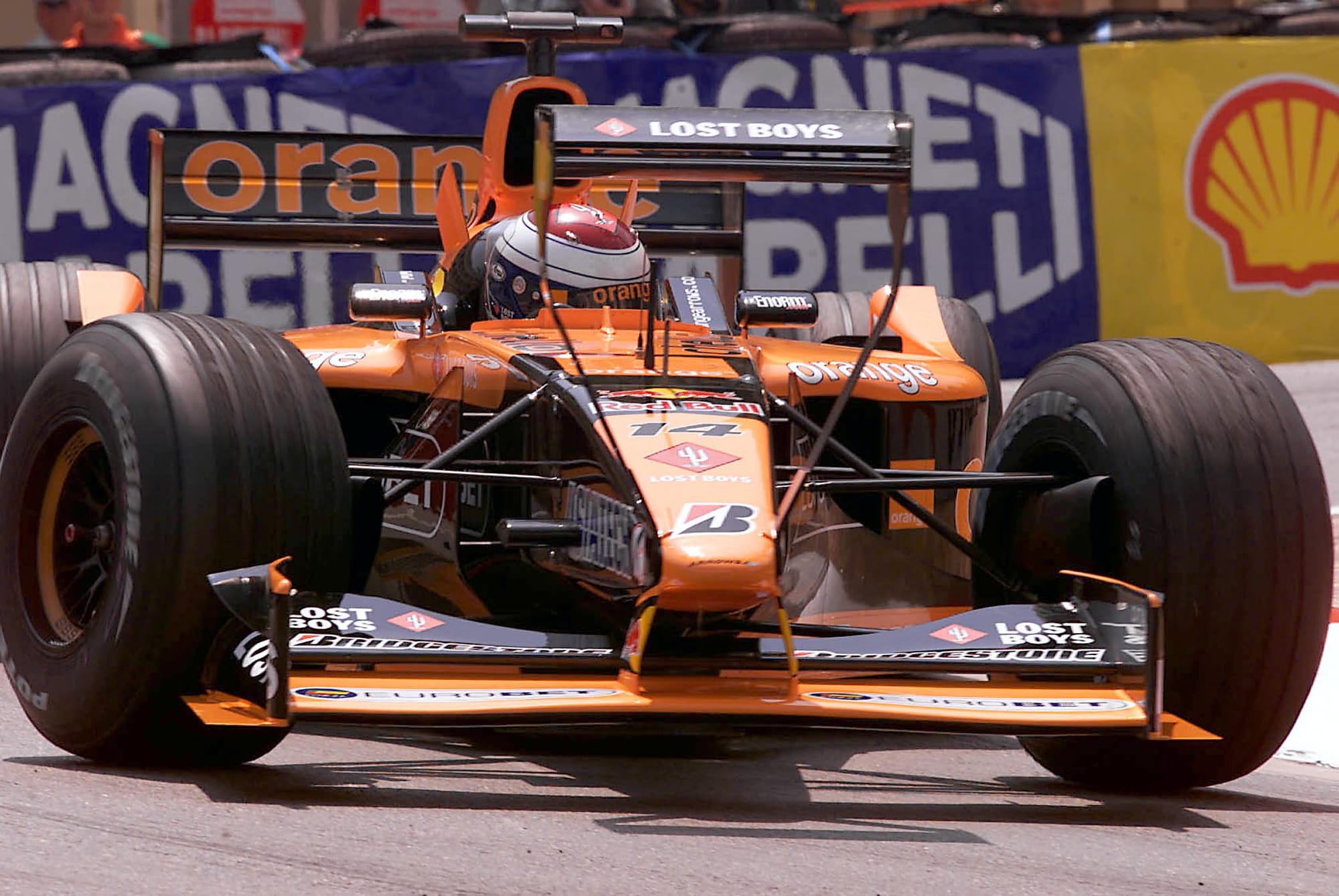
We have seen wings mounted in front of the drivers (remember the 2001 Arrows in Monaco, pictured below?), X-wings mounted high up off the sidepods, and the secondary wings each side of the actual rear wing coming over the rear tyres. The regulations have been tightened up to eliminate most of these appendages, but the active aero regulations have created an opportunity.
There is a position on the car’s centreline that makes allowance for the actual actuator and its fairing, which is above the normal wing height and not very wide. Teams are using it to generate that small amount of extra downforce for a track where you need as much as you can find.
Most teams have something, but I’m most impressed with the level that Mercedes has gone to, so that’s the assembly I’m analysing in detail. Others are doing something similar but to a lesser degree.
The objective is to use the area for the active aero actuator to influence the airflow direction and generate downforce. This will work on that central area in conjunction with the main wing assembly and, in turn, the central part of the diffuser where the crashbox and its small turning vanes are located.
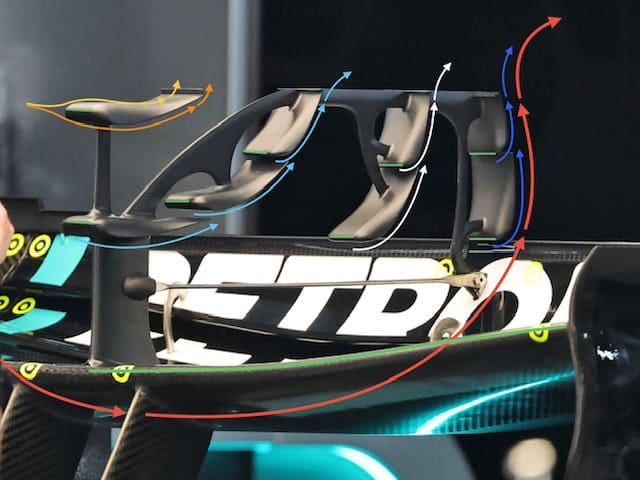
Working through the Mercedes wing assembly from front to back, I have highlighted each component with different coloured arrows. I have also highlighted the separation point of each element with a green line. This is the position where the airflow splits because of the differing pressures on the top and bottom of the element’s surfaces and decides what flow goes over the top and what goes underneath.
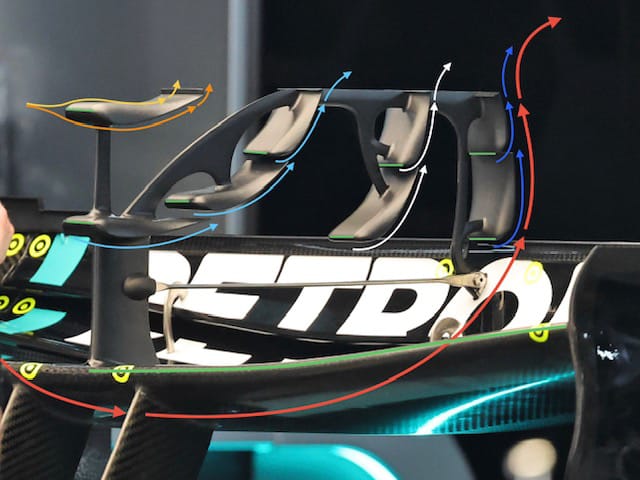
On the top forward element I have highlighted this flow separation with the orange arrows, showing what goes underneath, and the yellow arrows, showing what goes over the upper surface.
From there on in, it’s a cascade of elements. The second assembly of three elements is highlighted with the light blue arrows.
The third assembly is a two-element component highlighted with white arrows, and the rear fourth two-element component is highlighted with the dark blue arrows.
On all of them, there is a small Gurney flap right at the top rear trailing edge. This effectively acts as a trip helping the airflow on the undersurface of the elements stay attached, when generally it is getting a bit lazy.
The red line and red arrows from the front of the actual rear wing mainplane going underneath is to highlight the main objective, which is to help optimise and/or improve the consistency of this flow. If this can be done then that lower pressure under that central section of the wing will dissipate further outboard, so it’s not just a small section of wing that is improved – it can be the complete rear-wing undersurface.
So is such a tiny development really worth it, both in laptime and financial investment?
Financially, with current 3D printing machines, this sort of component – once optimised in CFD and modelled for manufacturing – would probably cost £250 to £500 per unit.
Assuming that it is all working as planned, I would suggest that as it will help rear-end stability under braking, which is critical for Monaco generally, it would add probably a few kilograms of extra rear end downforce.
The teams are playing down the importance of this area of development and some suggest it’s only worth a few hundredths of a seconds. Those hundredths all add up but overall I wouldn’t be surprised to see upwards of a two-tenths-of-a-second-per-lap improvement from the Mercedes design. So if that all works out it will be the cheapest two tenths of a second that any team could bring to the show, so well done to all at Mercedes.
The others have various different, smaller-scale interpretations of the same theme and that’s why they are probably playing down what I consider the potential laptime improvement. It’s the Mercedes package that I am most impressed with and for sure it has the biggest potential for performance gains.
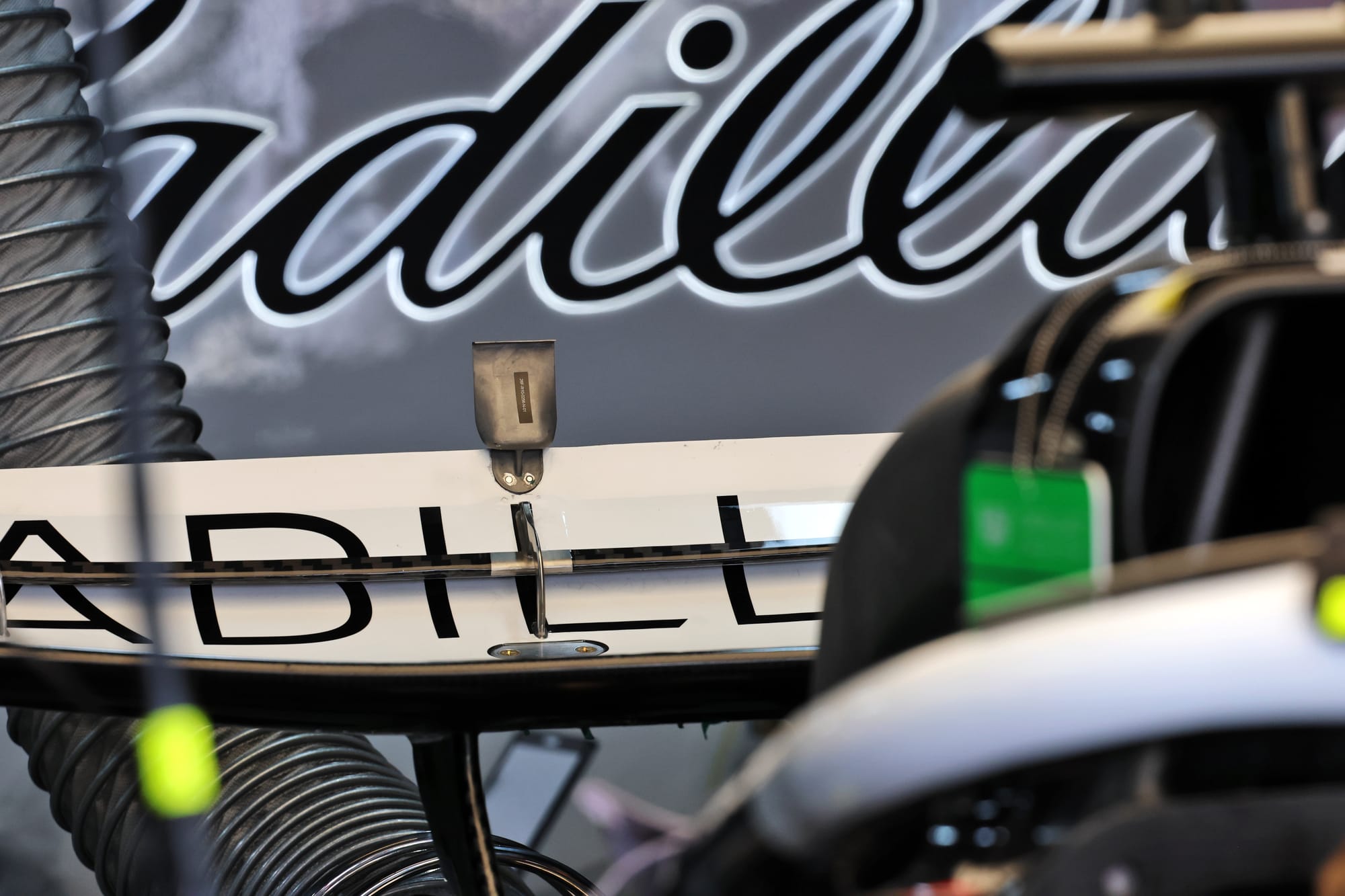
The variation between Mercedes and Cadillac just shows why there is a difference in the competitive level from the front to the back of the grid.